Back To All Resources
The Working Capitalist
The Cash Conversion Cycle: The Metric Defining Your Working Capital Health
May 26, 2026
Read time:
8 min
May 26, 2026
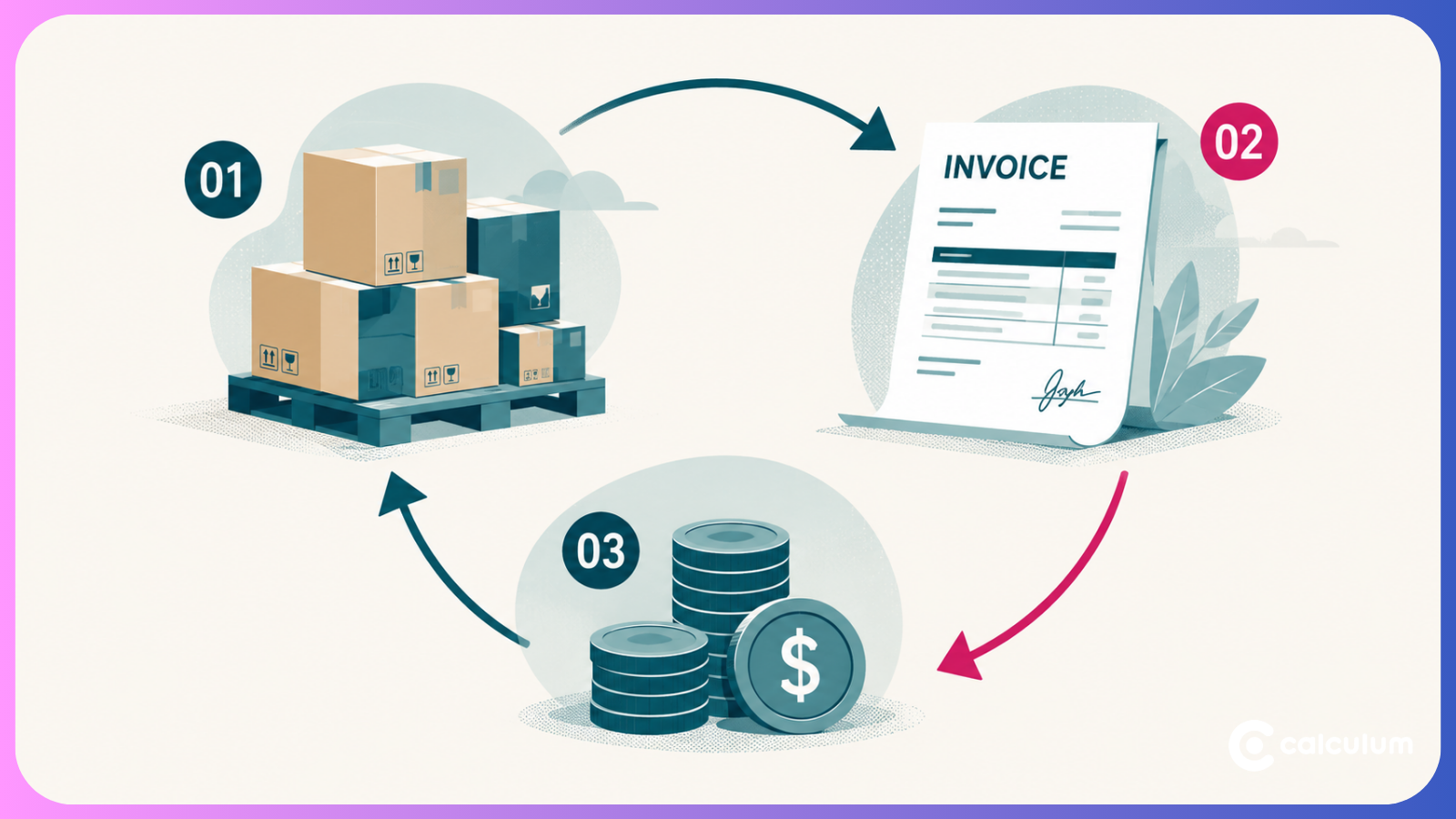
The Cash Conversion Cycle, also called the cash-to-cash cycle (C2C) or working capital cycle, is a financial performance metric that measures how long it takes a company to convert its investments in inventory and supplier payments into cash collected from customers.
It is defined by a simple but powerful formula:
C2C = DSO + DIO - DPO
Where:
The shorter the C2C, the less time capital is tied up in operations and generally, the healthier the business. A company with a short cash conversion cycle collects receivables quickly, moves inventory efficiently, and takes advantage of extended payment terms with suppliers.
Working capital, the difference between current assets and current liabilities, is the standard measure of short-term financial health. But it is a static snapshot. The Cash Conversion Cycle adds a dynamic, time-based dimension: how efficiently is that capital being turned over?
A company with positive working capital might still be in trouble if it cannot convert inventory or receivables to cash quickly. Conversely, companies like Dell and Walmart have operated with negative working capital for years, not because they are financially distressed, but because they are extraordinarily efficient at converting inventory to sales and collecting payment before paying suppliers.
Dell's strategy is instructive: by taking customer orders before initiating production, the company achieved near-zero inventory. Its DIO stood at just 32 days in the mid-1990s compared to competitors averaging 58 days, a structural advantage that fueled its growth without requiring proportional working capital investment.
Improving the Cash Conversion Cycle requires managing all three components:
Shortening Days Sales Outstanding means accelerating the collection of customer receivables. Strategies include tightening credit terms, improving invoice accuracy, offering early payment incentives, and using receivables financing or dynamic discounting on the customer side.
Reducing Days Inventory Outstanding requires more efficient supply chain management, better demand forecasting, just-in-time procurement, and improved logistics. Inventory reduction is often the highest-impact lever for manufacturers and retailers.
Extending Days Payable Outstanding, paying suppliers later, is the most direct lever for improving C2C and working capital from the payables side. But this lever must be managed carefully. Terms must be negotiated based on real-time data insights on each individual supplier, and not just a blank term increase without market intelligence.
The link between C2C and enterprise value
The Cash Conversion Cycle is not just an operational metric, it has direct implications for enterprise value. A 25% reduction in the C2C cycle of an average manufacturing company corresponds to an increase in enterprise value of approximately 7.5%, according to empirical research. The mechanism is straightforward: a shorter C2C releases idle capital, increasing free cash flow. That free cash flow can be reinvested, returned to shareholders, or used to reduce debt, all of which improve valuation.
Companies that continuously improve their C2C performance are also rewarded with better profitability. Research confirms a statistically significant negative relationship between C2C length and profitability: longer cash conversion cycles correlate with lower operational profit margins.
The optimal C2C varies significantly by industry. Retailers who collect cash from customers before paying suppliers can sustain negative C2C. Manufacturers with complex multi-stage production may have structurally longer cycles. Comparing companies across industries on C2C without adjustment is misleading.
Company size also matters. SMEs exhibit 27% higher C2C than large companies on average, equivalent to 13 additional days. This is primarily because larger companies have more negotiating power to extend payables and collect receivables faster, while SMEs face the opposite dynamic.
Improving C2C through aggressive DPO extension can be a zero-sum game: what the buyer gains in working capital, the supplier loses in cash flow. But it doesn't have to be.
Supply Chain Finance (SCF) transforms working capital from a zero-sum conflict into a win-win structure: buyers extend terms and improve DPO, while suppliers access early payment at favorable rates through the buyer's credit strength. The result is liquidity improvement for both parties without the supply chain fragility that aggressive unilateral term extension creates.
The Cash Conversion Cycle is a financial metric that measures how long it takes a company to convert its working capital investments, inventory, receivables, and payables into cash. It is calculated as DSO (Days Sales Outstanding) + DIO (Days Inventory Outstanding) minus DPO (Days Payable Outstanding). A shorter C2C means less capital is tied up in operations, and generally indicates a healthier, more efficient business.
Working capital (Current Assets minus Current Liabilities) is a static measure of short-term financial health at a point in time. The Cash Conversion Cycle adds a time dimension, it shows how efficiently the company converts working capital investments into cash through its operating cycle. A company can have positive working capital but a long C2C, indicating inefficiency, or negative working capital with a short C2C, indicating high operational efficiency.
A company can improve its C2C by reducing DSO (collecting receivables faster), reducing DIO (managing inventory more efficiently), or increasing DPO (extending payment terms with suppliers). In practice, DPO extension is the fastest lever, but it must be balanced against supplier financial health. Supply Chain Finance offers a way to extend DPO without creating financial stress for suppliers.
A shorter C2C means less capital is tied up in operations, which increases free cash flow. Higher free cash flow improves a company's ability to service debt, pay dividends, fund growth, and reduce its cost of capital, all of which are positively valued by markets. Research has found that a 25% reduction in C2C corresponds to approximately a 7.5% increase in enterprise value for an average manufacturing company.
Calculum helps enterprise teams optimize the DPO component of the Cash Conversion Cycle with greater confidence and precision. By benchmarking payment terms on each single supplier and insights on what terms are accepted from other customers, Calculum identifies where terms can be aligned, and where Supply Chain Finance or other tools can support the optimization. The result is improved C2C performance without supply chain fragility.
.png)