Back To All Resources
Articles
Data Insights on Suppliers as the Ultimate Lever
June 10, 2026
Read time:
7 min
.png)
June 10, 2026
In modern B2B procurement, the negotiation of payment terms has always been an asymmetric game. Suppliers traditionally hold the upper hand in information, a phenomenon known as The Seller's Information Advantage. They know what your competitors are paying, what their true cost of capital is, and where the real boundaries of flexibility lie.
The buyer, traditionally, does not. And in game theory, the party with better information wins.
But the rise of supplier intelligence platforms is changing that equation. When a buyer has access to real-time benchmarking data, the entire negotiation moves from a stochastic, multi-round game into something far more decisive: a Stackelberg leader-follower model, where the buyer moves first with confidence, and the supplier optimizes their response within a much narrower set of options.
This is not a soft transformation. It is a fundamental restructuring of how payment terms get set.
The Four Reasons Suppliers Have Always Had the Information Edge
Suppliers sell to many different buyers, often within the same industry. They know exactly when your competitors are paying, what terms they have accepted, and where the market floor actually sits. Buyer X just accepted 60-day terms while you are still asking for 90. The supplier knows this. You do not.
Suppliers also know their true Weighted Average Cost of Capital. They know exactly how much a 30-day payment increase costs them in interest or factoring fees. Without this internal visibility, buyers have historically been forced to take supplier claims of impossibility at face value.
Then there is product-specific knowledge. Suppliers understand the operational intricacies of their production cycles better than anyone. They can tie payment terms to operational necessity with claims that buyers have no way to verify.
And finally, tactical silence. In a traditional negotiation, the buyer reveals their needs first. The person who speaks first often gives away their reservation price. Suppliers respond, not lead, and in doing so they anchor the negotiation around their own favorable terms.
Traditionally, buyers only saw their own data. They had no way of knowing if their requested terms were market standard or aggressive without a tool providing supplier-specific insights on payment terms.
From Nash Equilibrium to Stackelberg Leadership
In a Nash equilibrium, no player can benefit by changing their strategy unilaterally. It is often described as a point of no regrets. But a Nash equilibrium is not necessarily the best outcome for either party. In payment terms negotiations, information asymmetry usually hides the true equilibrium. When you reveal the truth, the equilibrium shifts toward the party with the better data.
When a buyer possesses superior market intelligence, the game changes shape entirely. The buyer moves first with a firm, data-backed requirement. The supplier observes that move and chooses their best response, with their options effectively restricted to three: accept the terms, request a price adjustment, or exit the relationship.
This is the Stackelberg model in action. The buyer leads, the supplier follows, and the buyer's first-mover advantage is grounded in data rather than aggression. Crucially, the Stackelberg buyer only succeeds if their information is accurate. If they set a term that is genuinely impossible for the supplier, they fail. This is why the data layer matters so much. It is what separates a sophisticated negotiation strategy from a blunt power play.
Why Data Is the Ultimate Lever
Data is the ultimate weapon in modern procurement. It transforms negotiation from a subjective debate into an objective reality. In this buyer-centric model, the competitive advantage is no longer just size, it is the analytical precision based on benchmark data for each individual supplier and real-time market signals.
By using Calculum to identify exactly where a supplier and its competitors have set the market floor on payment terms, the buyer eliminates the risk of the unknown and replaces intuition with evidence. The result is a mathematically optimized treasury that treats the supply chain not just as a source of goods, but as a strategic reservoir of interest-free capital.
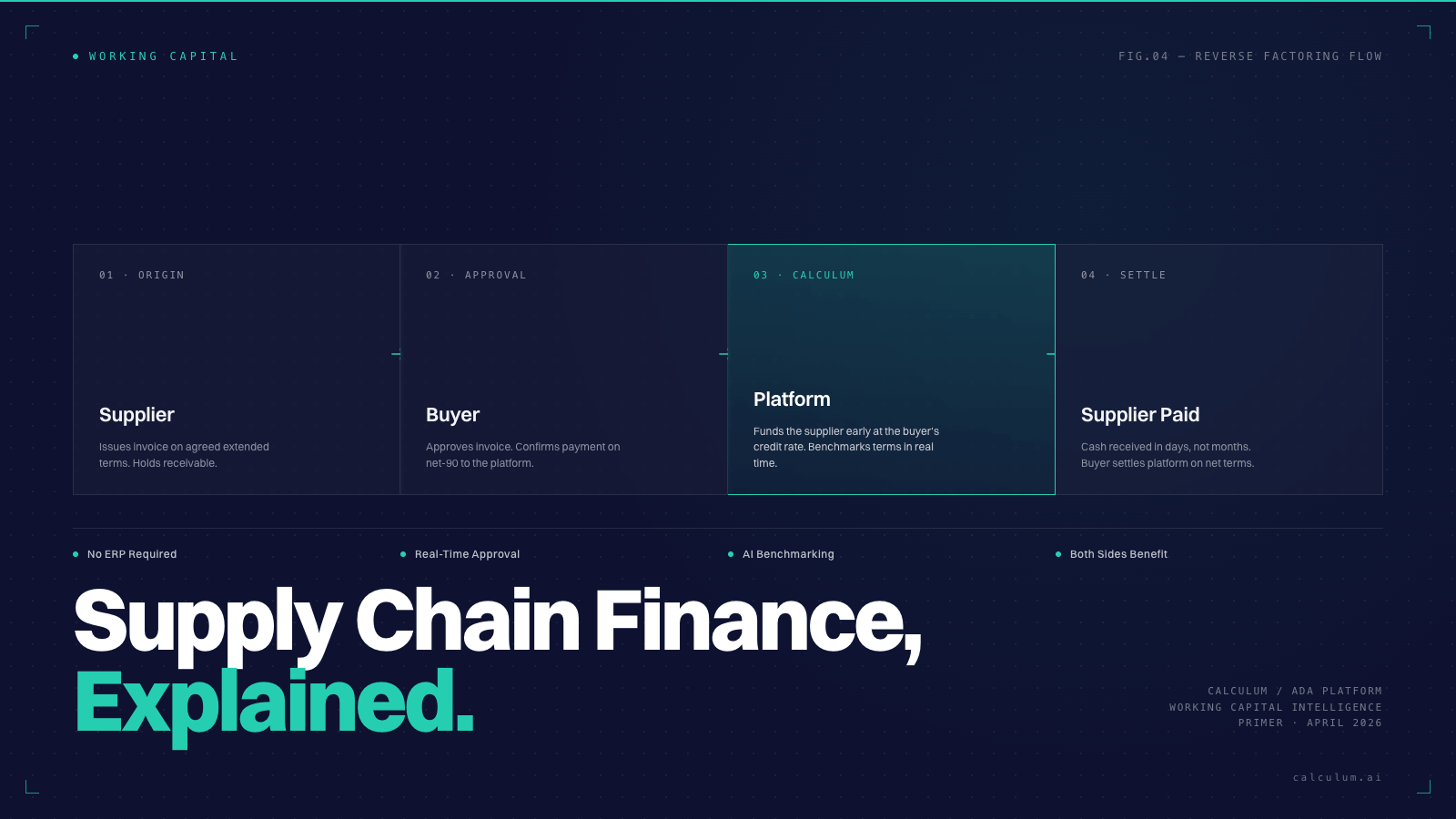
The full report covers the complete framework, including how to overcome supplier price-term parity defenses, why early payment can inadvertently fund your competitors through the de facto bank effect, how to use the shadow of the future as a negotiation lever, when to apply term discrimination across a supplier portfolio, and how Supply Chain Finance can turn payment term extensions into a positive-sum game.
Ultimately, information is the only currency that never loses value. The party with the most accurate data does not just win the negotiation. They define the rules by which it is played.