Back To All Resources
Articles
How to Improve Working Capital Without Financing
May 6, 2026
Read time:
9 min
May 6, 2026
Working capital is the measure of operational liquidity: the cash available to fund day-to-day business operations. Improving it is one of the CFO's highest-leverage responsibilities. It is also one of the most consistently underpursued, because the conventional solution (raising a revolving credit facility) is more visible and familiar than the operational alternatives.
This guide provides a step-by-step playbook for improving working capital through payment terms optimization, accounts receivable management, and inventory discipline, without new external financing. Each step includes specific actions for finance and procurement teams to implement. For a quick overview of the main levers available, see 8 no-financing ways to unlock working capital.
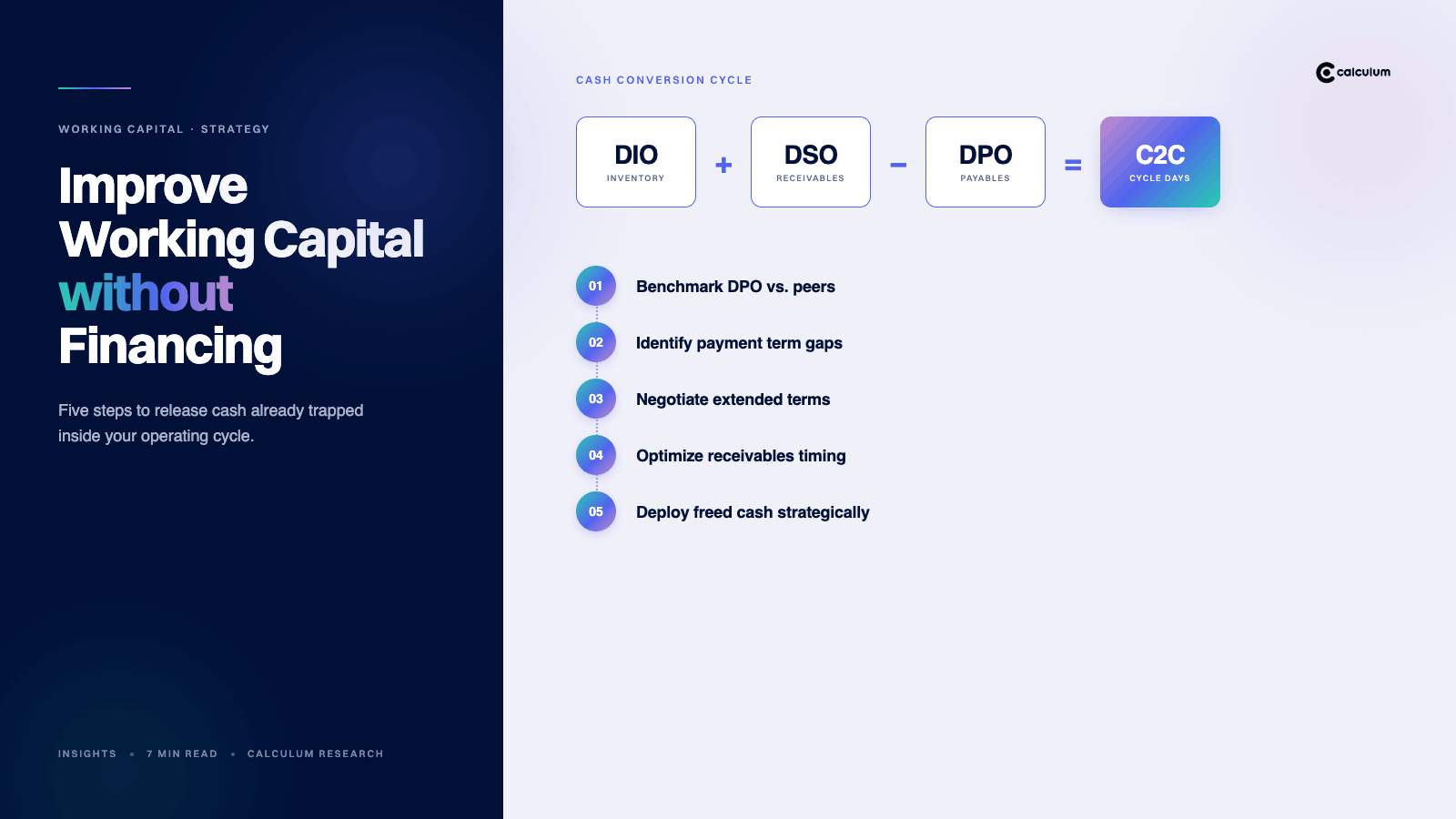
You cannot improve what you have not measured. Begin by calculating your current position across the three components of the cash conversion cycle:
Internal metrics tell you where you are. External benchmarks tell you where you should be. The benchmark gap is where the working capital opportunity lives.
For DPO specifically, sector benchmarks vary widely: retail and consumer goods typically operate with higher DPO than professional services or construction. A DPO of 45 days may be above average in one sector and significantly below average in another. Benchmarking must be sector-specific to be meaningful. Use Calculum's peer group comparison tool to see how your DPO and DSO stack up against relevant peers.
For DSO, customer concentration, contract terms, and billing cycle frequency are key drivers of variance. Benchmark against comparable companies in your sector to identify whether your DSO performance is within market norms or represents an improvement opportunity.
Once benchmarked, most enterprises find that one of the three components (DPO, DSO, or DIO) carries a substantially larger gap versus peers than the others. For large buyers in manufacturing, retail, and consumer goods, the DPO gap is typically the dominant opportunity, because payment terms are frequently below market and directly negotiable.
Quantify the cash impact of closing the benchmark gap. For DPO: multiply the days gap by annual COGS divided by 365. For DSO: multiply the days gap by annual revenue divided by 365. This produces a specific, defensible cash improvement target. Calculum's opportunity calculator does this automatically for your specific payables and receivables base.
Not all trading partners are equal in the working capital equation. A tiered approach to payment terms optimization produces better outcomes than treating all suppliers identically:
The most important enabler of successful payment terms negotiation is external benchmark data. A procurement team that can demonstrate to a supplier that their current 30-day terms are below the sector median of 55 days is negotiating from a position of market legitimacy rather than buyer pressure.
Effective payment terms negotiations at the strategic tier follow a consistent structure: present the market benchmark, acknowledge the trading partner's business position, offer supply chain finance access as part of the proposal, and frame extended terms as the market standard rather than a buyer demand. For more on building this negotiation framework, see our guide to quantifying payment terms cash flow impact.
Supply chain finance programs allow strategic vendors to access early payment on their receivables at a financing rate tied to the buyer's credit rating, which is typically lower than the supplier's own borrowing cost. This means the trading partner can be paid earlier than the extended terms would suggest, at a cost they often find attractive compared to their bank line.
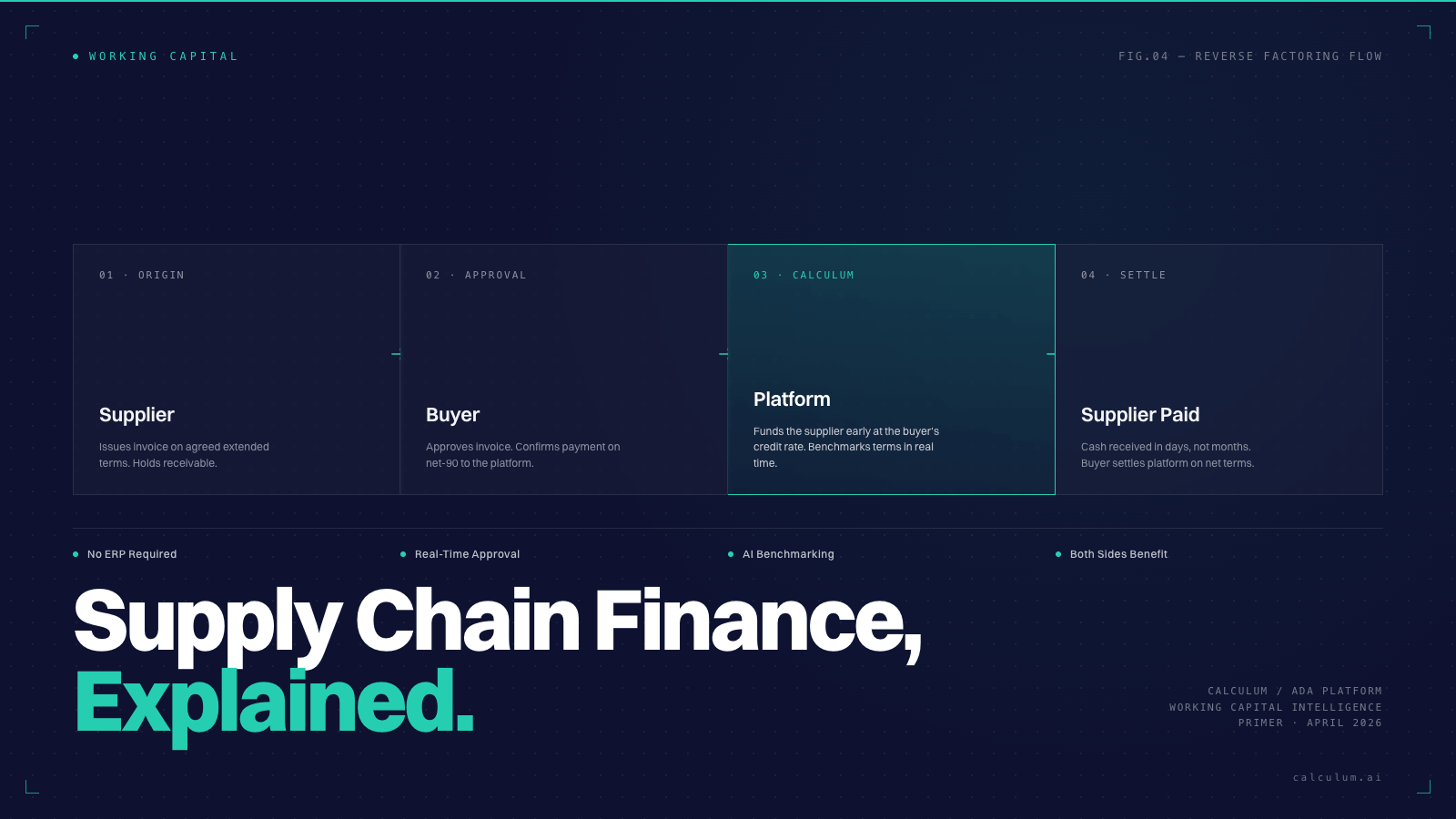
For buyers, supply chain finance programs remove the main objection to extended term negotiations: that the supplier cannot absorb the cash flow impact. A well-structured supply chain finance program makes extended terms commercially viable for both parties. For a primer on how these programs work, see our guide to supply chain finance.
On the receivables side, DSO improvement comes from four operational levers: invoice accuracy and timeliness (errors that trigger disputes delay payment), automated payment reminders and dunning workflows, early payment incentives for high-volume customers, and dispute resolution speed for contested invoices.
DSO improvement is often more immediately actionable than DPO improvement because it requires process changes within the business rather than external negotiations. For companies where DSO is significantly above the peer benchmark, it should be prioritized alongside or ahead of the payables program.
Inventory optimization requires demand forecasting accuracy, supplier lead time management, and safety stock discipline. Reducing excess inventory frees cash from the balance sheet without any external transaction. The opportunities are most significant in businesses with long supply chains, seasonal demand patterns, or historically conservative safety stock policies.
Working capital improvement programs that are implemented once and not governed tend to erode. Payment terms drift as suppliers push back during contract renewals. DSO rises as collections processes lose discipline. Inventory creep returns as safety stock assumptions are revised upward.
Continuous benchmarking, quarterly DPO and DSO reviews against the peer baseline, and active governance of payment terms across the supplier base sustain improvement over time. The technology infrastructure that enables this governance, connecting payables and receivables data to external benchmarks and surfacing new opportunities automatically, is increasingly the differentiator between companies that achieve lasting working capital improvement and those that revert. See how Calculum's platform delivers this continuous intelligence layer, no ERP integration required.
.png)