Back To All Resources
Articles
How to diagnose which root cause is hurting your payment terms initiative
September 3, 2026
Read time:
3 min
September 3, 2026
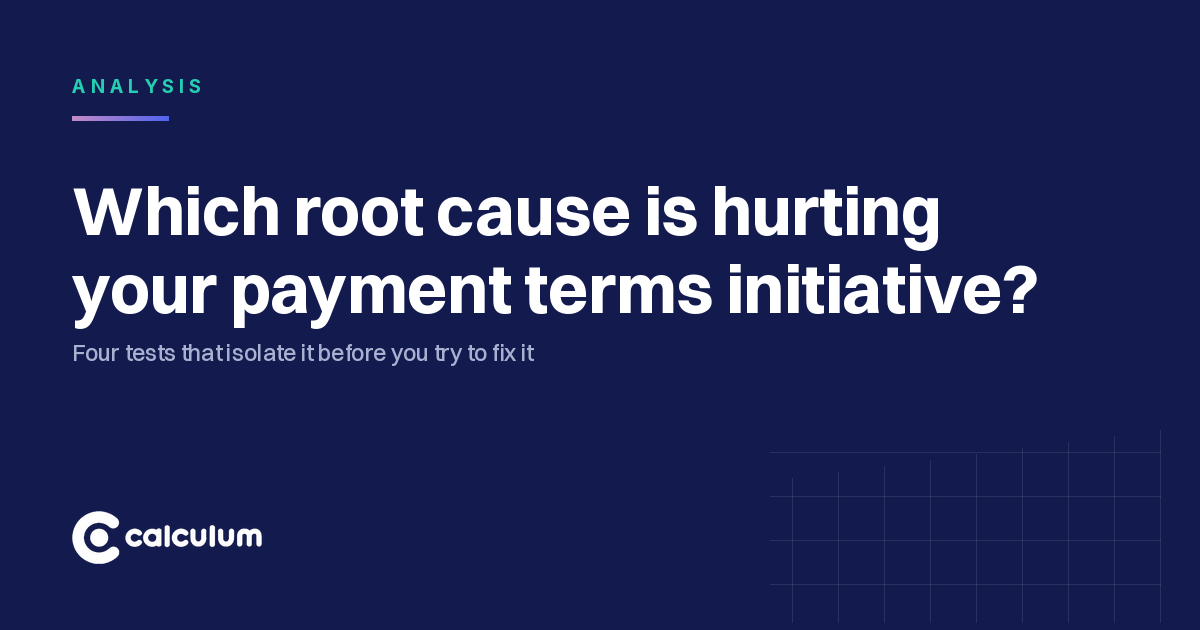
Run four tests in order: was the baseline accurate, were targets set against the market, did the negotiations conclude successfully, and are the negotiated payment terms actually reflected in payment behavior. The first test that fails identifies the root cause. Testing in this order prevents remediating the wrong issue.
The order matters because each test assumes the previous one passed. Improving negotiation technique while the underlying data remains inaccurate will produce better conversations with the wrong trading partners.
Review the original spend file and establish what share of trading partner records held complete, current payment terms. Look for missing payment terms data, duplicate records and inconsistent naming across business units.
If a material share was incomplete, the targets were set against a partial picture, and the difference between target and result may not represent a failure at all. It may represent an opportunity that was never visible.
Establish where the target numbers originated. If they came from internal history, a prior initiative, or a percentage improvement applied uniformly across the base, they were not derived from market intelligence, making it difficult to determine whether the market will support them.
A target such as "extend every supplier by 15 days" is an assumption applied uniformly. A target built from relevant market benchmarks across comparable companies, suppliers and regions is grounded in market intelligence and far more likely to hold up in negotiation.
Measure contracted outcomes rather than conversations held. Compare signed payment terms against the target for each trading partner approached, and examine whether success rates cluster by category.
Significant variation between categories usually indicates an issue with the approach rather than the target. What works with commodity suppliers frequently fails with strategic partners, who require a different conversation.
Compare contracted payment terms against actual payment dates for every relationship where payment terms were renegotiated. This is where initiatives that appear successful on paper lose their value.
Payment terms agreed at net 60 and paid on day 40 leave 20 days of the negotiated improvement uncaptured. Where tests 1 to 3 pass and the working capital position still has not moved, terms leakage is the most likely explanation.
Tests 1 and 4 both draw on the same two data points: contracted payment terms and actual payment dates, per trading partner. Test 2 requires external market intelligence. Test 3 requires negotiation outcomes recorded against the original targets, which is the data point most often missing, because outcomes tend to be tracked as activity rather than against a target.
Most remediation effort is directed at test 3, because negotiation is the most visible part of the work. In practice, the failure can sit at test 1 or test 4, both of which are often less visible than the negotiation itself. Calculum benchmarks payment terms at trading partner level, which allows tests 1, 2 and 4 to be answered from data rather than from opinion.
Once the root cause is identified, the remediation sequence is in how to fix payment terms target misses in 7 steps.
.png)