Back To All Resources
Articles
Beyond Traditional Supply Chain Finance: Five Lessons from the Working Capital Innovation Webinar Series
November 11, 2026
Read time:
4 min

November 11, 2026
For years, Supply Chain Finance (SCF) has been one of the most effective tools available to treasury teams looking to improve working capital while supporting suppliers with access to liquidity. Yet as organisations face increasing pressure to optimise working capital, navigate payment term regulations, and maintain resilient supplier relationships, many are discovering that a single solution is no longer enough.
Across two recent webinars featuring Karel Krejčí of Calculum, Simon Allen of Orbian, and Olamide Olaofe of Rabobank, one message came through consistently: the future of working capital lies in combining the right solutions, supported by data and AI-driven insights, rather than relying on any single programme alone.
As treasury teams look beyond traditional approaches, a new model is emerging, one that combines Supply Chain Finance, Deferred Payment Solutions and AI-powered supplier intelligence into a single working capital strategy.
One of the clearest themes from both discussions was the changing role of working capital within corporate finance.
Historically, many organisations viewed working capital programmes primarily as procurement or treasury initiatives. Today, they are increasingly being treated as a strategic source of liquidity.
Businesses face seasonal cash requirements, market volatility and growing pressure to protect balance sheets. At the same time, new regulations around payment terms, increased accounting scrutiny and supplier expectations are making traditional approaches more complex.
As a result, companies are looking for solutions that provide more flexibility, broader supplier coverage and faster access to liquidity than traditional models can often deliver.
Throughout both sessions, the speakers were careful to emphasise that Supply Chain Finance remains a highly valuable and relevant tool.
The issue is not that SCF is failing.
The issue is that even successful programmes often struggle to reach the entire supplier base.
Many organisations achieve strong participation among their largest suppliers but encounter challenges when attempting to expand to mid-tail and long-tail suppliers. Adoption rates can remain below expectations, onboarding processes can create friction, and some suppliers simply have little incentive to participate. In other cases, suppliers may already have strong access to financing or may be reluctant to renegotiate payment terms.
This leaves treasury teams with an important question:
How do you unlock working capital opportunities across the entire supplier ecosystem rather than only a portion of it?
This is where Deferred Payment Solutions, such as Orbian's FlexPay solution, are increasingly attracting attention.
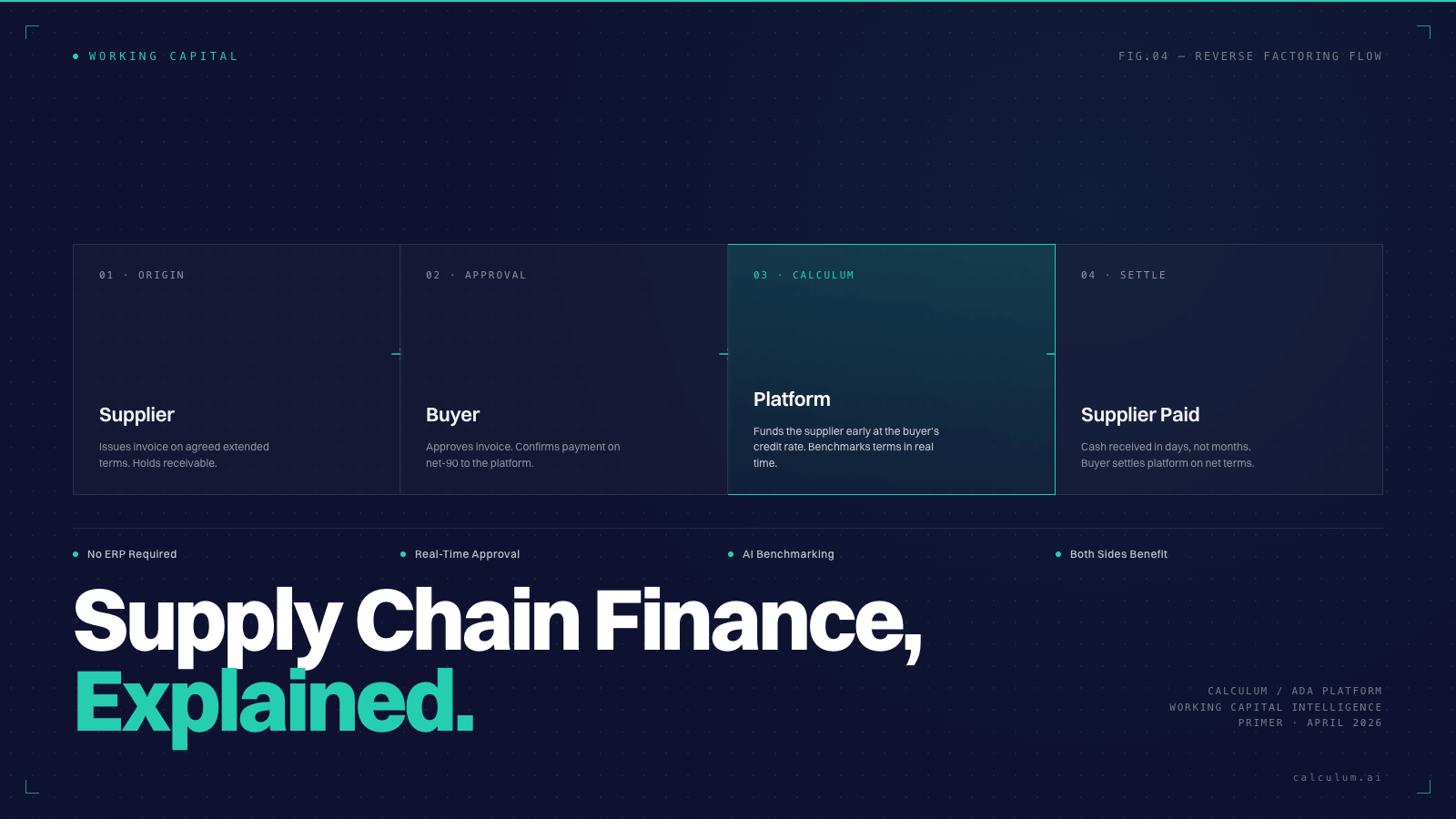
Unlike traditional SCF programmes, which require supplier participation and payment term negotiations, a Deferred Payment Solution allows suppliers to continue receiving payment on their agreed terms while funding partners provide the buyer with extended settlement periods.
The practical advantage is simplicity.
Depending on the structure, suppliers may not need to onboard or renegotiate their terms, which can simplify implementation and help buyers access additional liquidity while maintaining supplier relationships. Orbian shared that a growing proportion of market discussions and RFPs now include some form of deferred payment structure alongside more traditional working capital solutions.
Perhaps most importantly, both Orbian and Rabobank highlighted that Deferred Payment Solutions should not be viewed as competitors to SCF.
They work best when used together.
If there was one concept repeated throughout both webinars more than any other, it was data.
Working capital initiatives have traditionally relied on broad assumptions about supplier behaviour, payment terms and adoption rates. However, treasury teams now have access to far richer insights than ever before.
Calculum's platform draws on extensive global supplier data to help companies benchmark payment terms, understand supplier profiles, prioritise working capital opportunities and inform supplier engagement. Rather than applying a generic strategy across an entire supplier base, organisations can make more informed, supplier-specific decisions.
The key question is no longer:
"Can we implement an SCF programme?"
Instead, it becomes:
"Which suppliers are best suited to SCF, which are better suited to deferred payment solutions, and where should we prioritise our efforts?"
This shift from assumption-based decision making to data-driven segmentation is fundamentally changing how working capital programmes are designed.
The second webinar moved beyond theory and demonstrated how organisations can use a hybrid model in practice.
The case study presented by Rabobank, Orbian and Calculum illustrated one possible approach: using a Deferred Payment Solution to address near-term liquidity objectives, while applying AI-driven supplier analysis to identify groups that may be well suited to Supply Chain Finance. The appropriate sequence and mix depend on the company's supplier base, funding needs and commercial priorities.
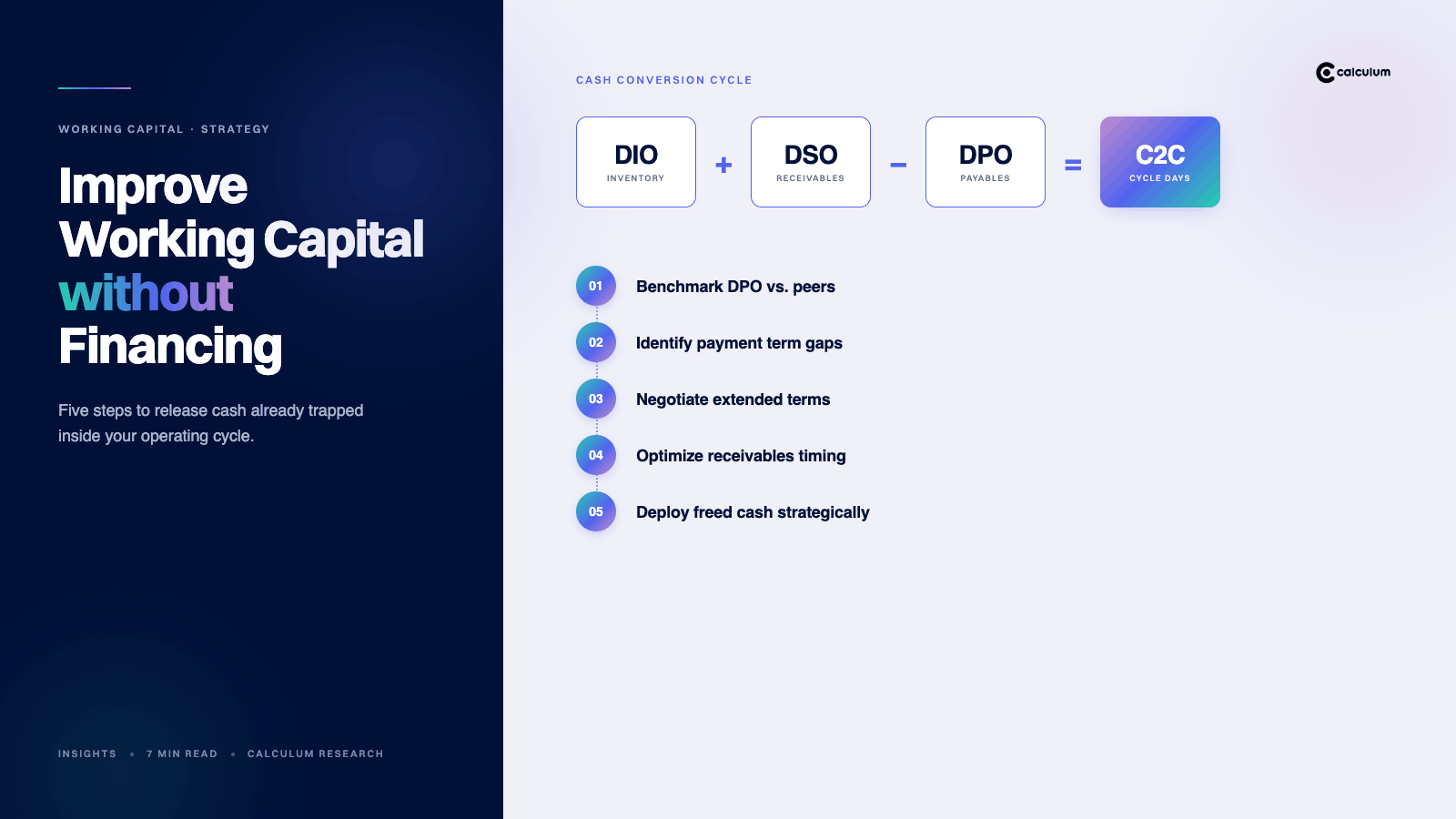
The case study highlighted a practical set of steps that companies can adapt to their circumstances:
The result can be a more flexible programme, designed around the needs of different supplier groups rather than a single approach.
Another recurring lesson from both webinars was that successful working capital programmes are rarely delivered by treasury teams alone.
Treasury may own the liquidity objectives, but procurement owns supplier relationships. Banks provide funding capacity. Technology providers contribute data, insights and implementation support.
The strongest programmes emerge when all stakeholders work from the same set of objectives and the same data.
Supplier benchmarking, AI-driven segmentation and clear supplier engagement strategies help procurement teams approach negotiations with greater confidence and make informed decisions based on facts rather than assumptions.
If the webinar series revealed one thing, it is that working capital optimisation is entering its next phase.
The future will not be defined by choosing between Supply Chain Finance and Deferred Payment Solutions.
Instead, organisations will increasingly adopt hybrid programmes that combine multiple financing tools, supported by AI-powered data analytics and flexible funding structures.
As Simon Allen of Orbian observed, flexibility is becoming an important requirement for treasury teams. And as Olamide Olaofe of Rabobank emphasised, the objective is to build the right combination of solutions for each company's supplier ecosystem, risk profile and working capital goals. Calculum's supplier intelligence capabilities illustrate how data and AI can help organisations make those decisions with greater confidence.
The question is no longer whether SCF or Deferred Payment Solutions are the better answer.
The real opportunity lies in combining both, using data to deploy each where it creates the greatest value.